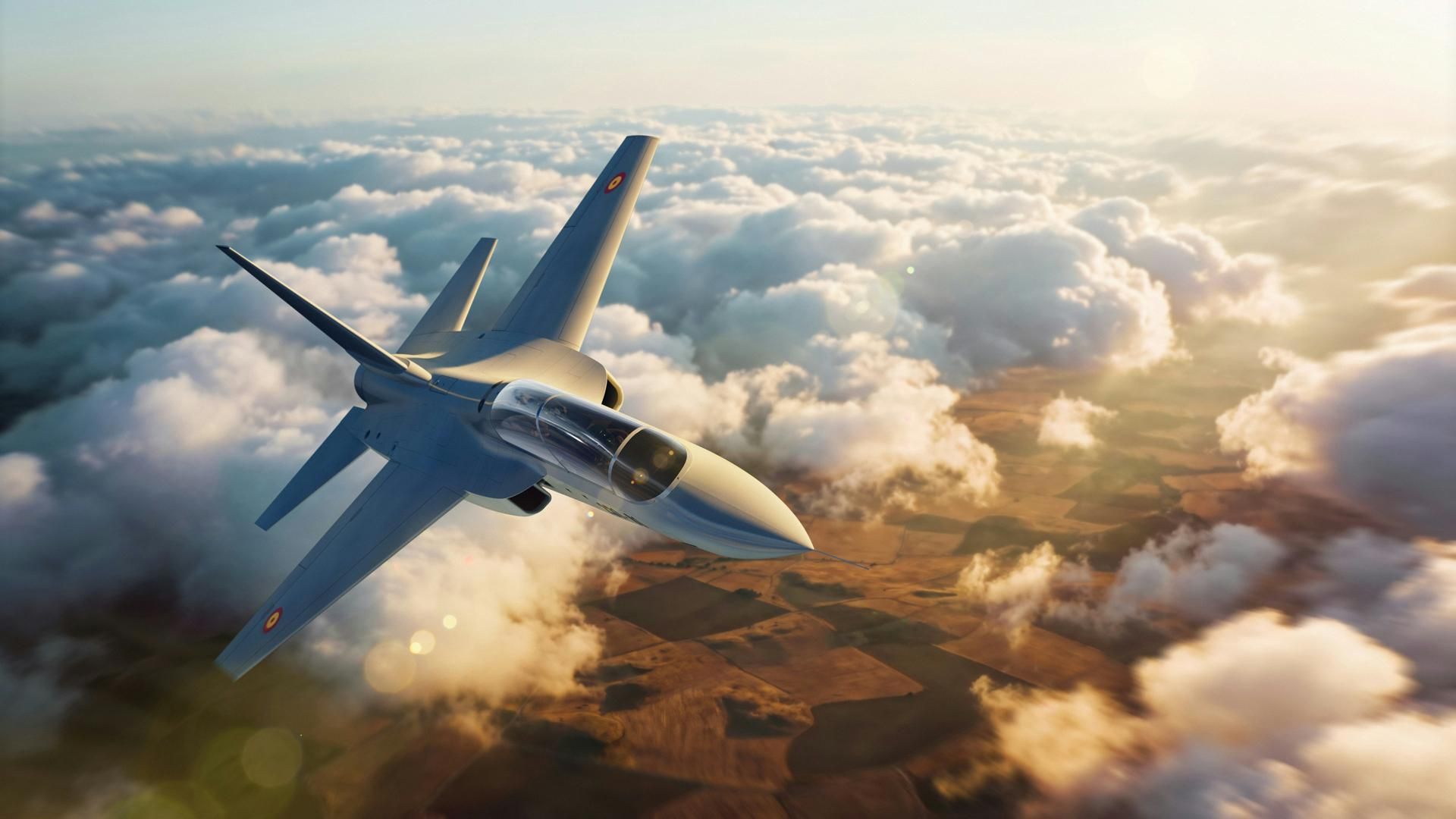
Picture credits: Airbus
 Click to view
May 15, 2026
Spain – An Airbus-led consortium of Spanish companies has formally presented the industrial program for the Spanish Air and Space Force's new Integrated Combat Training System (ITS-C), a program awarded under contract in December 2025 valued at EUR 2.4 billion (USD 2.8 billion) to replace the current fleet of F-5 aircraft used for advanced fighter pilot training.
- The ITS-C program is based on a co-development agreement between Airbus Defence and Space, as prime contractor and national coordinator for Spain, and Turkish Aerospace (TA), as manufacturer of the HÜRJET advanced jet trainer. Spain is the first European and NATO member country to procure the HÜRJET.
- The program covers the full advanced training process for Spanish fighter pilots, from Spanish-specification customization of a 30-aircraft fleet — designated nationally as the SAETA II — to the provision of integrated operation and maintenance services.
- Airbus will lead the redesign of the Fighter and Strike School Training Centre at Talavera la Real Air Base in Extremadura, including state-of-the-art simulators developed in collaboration with Indra, along with logistical support for operations and maintenance of both aircraft and synthetic training systems to ensure maximum fleet availability.
- The program runs in two phases. The initial phase, beginning in 2028, focuses on the delivery of 21 aircraft, with one used by Airbus as a prototype for the integration of next-generation avionics and mission equipment. A ground-based training system is scheduled to enter operation during the 2029–2030 academic year. In the second phase, all 21 aircraft plus the remaining 9 on order will undergo conversion to Spanish standards, with deliveries of the completed SAETA II variant and its ground-based training system between 2031 and 2035.
- The program includes 60% national industry participation. Beyond primary parts manufacturing, electrical wiring, and the design and construction of the conversion center, Spanish industry will integrate key national technologies for avionics and mission systems: GMV (Inertial/GPS and mission computer), Sener (DataLink), Aertec (remote interface unit), Grupo Oesía (audio management), Orbital (VMDR mission recorder), and Indra (Identification Friend or Foe system).
- Spanish industry, led by Airbus, will independently manage maintenance, currency, and evolution of the fleet, providing strategic sovereignty over the system's long-term sustainment.
- Two HÜRJET prototypes have completed approximately 340 flights and 260 flight hours in Turkiye, with Turkish Aerospace establishing a production line capable of manufacturing two aircraft per month.
Statements
- "As a result of this national programme, Spain achieves three strategic milestones: we ensure technology transfer in key areas, we obtain a deep-reaching industrial return, and, above all, we provide the programme with the strategic sovereignty and independence necessary to manage the sustainment and any future evolution of the system," said Marta Nogueira, Head of Business Spain at Airbus Defence and Space.
- "It is a project that mobilises our industry, generates knowledge, employment, and opportunities throughout the entire value chain. It strengthens our strategic autonomy by allowing us to design, integrate, and evolve our own capabilities, reducing critical dependencies," said Amparo Valcarce, Spanish Secretary of State for Defense.
Source: Airbus
You may also check our Terms and Conditions for our Content Policy. Searching for specific information - kindly contact us to see if we can assist you.
Related News
Page 1
Share
Loading Ad...
Recommend this Post
Please fill out the form below and the AFM platform will send this post via email to your preferred recipient