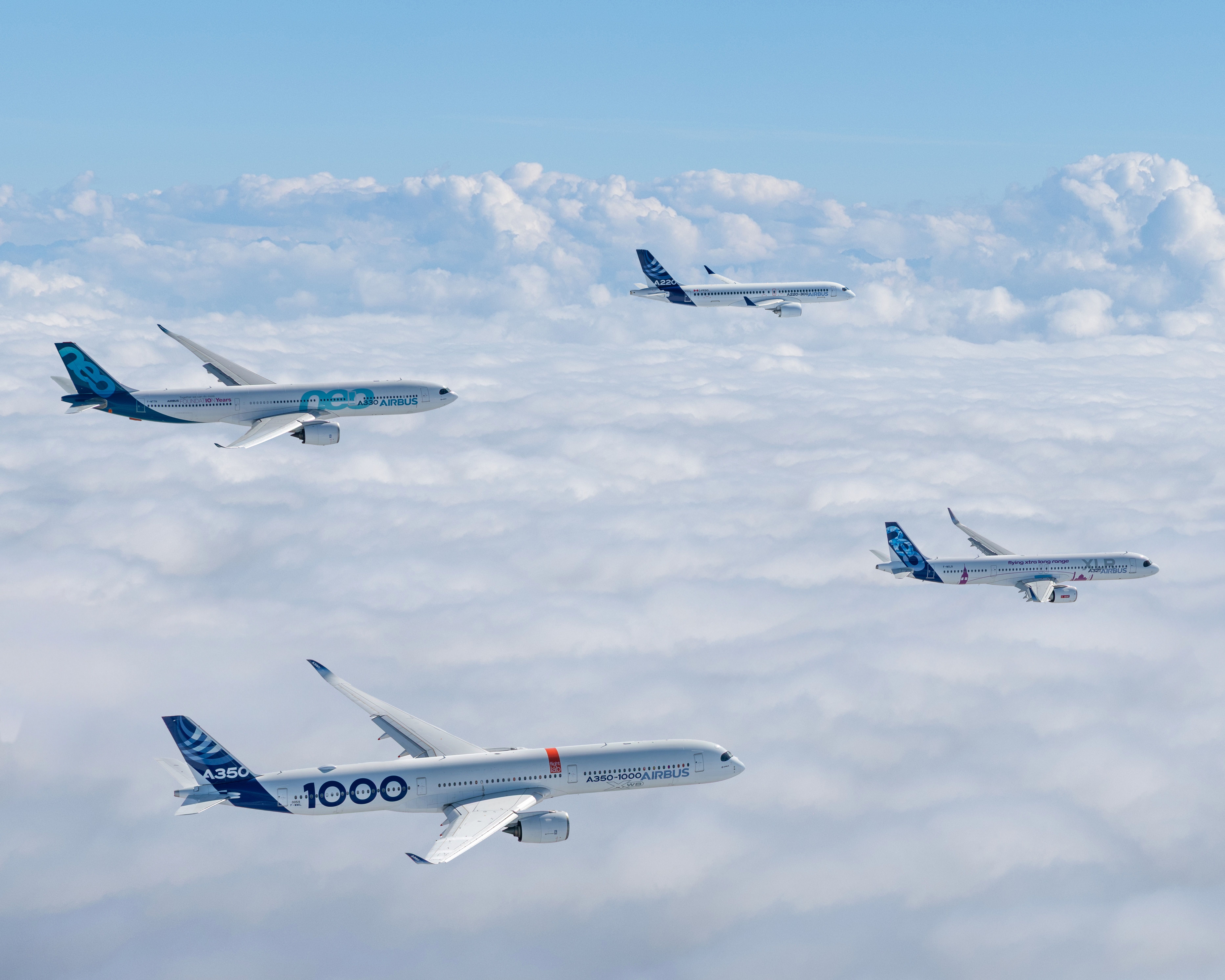
Picture credits: Airbus
 Click to view
July 31, 2026
Global – Airbus delivered 351 commercial aircraft during the first half of 2026 and retained its guidance for around 870 deliveries for the full year, while its medium-term plan targets more than 1,100 annual deliveries by 2029. The planned increase in aircraft entering airline fleets would raise requirements for Airbus type-rating, recurrent and maintenance training capacity.
- Airbus delivered 351 aircraft to 77 customers during the six months ended 30 June 2026, comprising:
- 44x A220s
- 271x A320 Family aircraft
- 10x A330s
- 26x A350s
- Deliveries increased approximately 15% from 306 aircraft in the first half of 2025.
- The total increased by 15% from 306 deliveries during the same period in 2025.
- Gross commercial aircraft orders reached 886, compared with 494 in H1 2025. After cancellations, net orders totalled 821 aircraft and the commercial backlog stood at 9,222 aircraft at the end of June.
- The H1 result represents an average delivery cadence of 58.5 aircraft per month. Airbus must deliver another 519 aircraft during the second half to reach its 870-aircraft guidance, requiring an average of 86.5 deliveries per month between July and December.
- Delivery activity accelerated from 114 aircraft during the first quarter to 237 during the second quarter, equivalent to a Q2 average of 79 aircraft per month. June represented the highest monthly total of 2026 at 89 deliveries, following 81 in May and 67 in April.
- Using H1 customer deliveries as an indicator of current cadence — rather than a direct measure of factory production — the aircraft-family comparison is:
- A220: 44 deliveries, averaging 7.3 per month, compared with Airbus’ target production rate of 13 per month in 2028. The H1 delivery cadence was approximately 56% of the targeted rate.
- A320 Family: 271 deliveries, averaging 45.2 per month, compared with the target of 70 to 75 per month by the end of 2027. The H1 cadence was approximately 60% to 65% of the targeted rate.
- A330: 10 deliveries, averaging 1.7 per month, compared with the target of five per month in 2029. The H1 cadence was approximately 33% of the targeted rate.
- A350: 26 deliveries, averaging 4.3 per month, compared with the target of 12 per month in 2028. The H1 cadence was approximately 36% of the targeted rate.
- The four targeted production rates would collectively represent a nominal output of 100 to 105 aircraft per month, or approximately 1,200 to 1,260 aircraft annually. Airbus separately expects to pass 1,100 annual commercial aircraft deliveries in 2029, indicating that headline production rates should not be treated as directly equivalent to customer deliveries during a calendar year.
- Airbus said 2029 represents the point at which all commercial aircraft programs should be operating at their targeted rates. The manufacturer expects the A350’s annual deliveries to more than double by that year compared with current volumes.
- Airbus operates ten A320 Family final assembly lines, which the company said are configured to support production of 75 aircraft per month and are capable of assembling the A321. Airbus identified engine availability, particularly from Pratt & Whitney, as the principal factor affecting the A320 Family production trajectory rather than a shortage of final assembly capacity.
- The manufacturer’s inventories increased by €6.9 billion during the first half, from €41.7 billion at the end of 2025 to €48.6 billion at 30 June 2026. Airbus attributed the increase primarily to work in progress intended to support the production ramp-up, demonstrating that aircraft production and recorded customer deliveries can occur at different times.
- Consolidated revenue increased 12% year on year to €33.2 billion. Commercial aircraft revenue rose 15% to €23.9 billion, reflecting higher deliveries and increased services activity, partly offset by the depreciation of the US dollar.
- Consolidated adjusted EBIT increased 24% to €2.73 billion, while reported EBIT rose 70% to €2.75 billion. Net income increased 47% to €2.24 billion.
- Airbus retained its 2026 guidance of around 870 commercial aircraft deliveries, approximately €7.5 billion in adjusted EBIT and approximately €4.5 billion in free cash flow before customer financing. The guidance assumes no additional disruption to global trade, air traffic, the supply chain, internal operations or Airbus’ ability to deliver products and services.
- Airbus identified training and digital solutions as part of its Commercial Aircraft Services business during its separate 21 July 2026 Business Update. The manufacturer is targeting US$10 billion in annual Commercial Aircraft Services revenue by 2030, covering spare parts, training, digital solutions and aircraft support activities.
- Airbus’ training infrastructure includes its recently completed Flight Operations & Training Skywise Campus in Toulouse, which has capacity for approximately 9,000 international trainees annually and space for up to 12 full-flight simulators. Its planned 2026 inventory includes seven EASA-certified full-flight simulators covering the A300/A310, A320, A330, A350 and A380 families.
- Airbus Helicopters delivered 144 aircraft, compared with 138 in H1 2025. It recorded 215 net orders and ended June with a backlog of 1,108 helicopters.
- Free cash flow before customer financing remained negative at €1.17 billion, compared with a €1.61 billion outflow in H1 2025. Airbus attributed the outflow mainly to working-capital changes and planned inventory accumulation supporting production increases across its businesses.
- Airbus forecasts that the aviation sector will require 633,000 new pilots, 705,000 technicians and 1.01 million cabin crew members between 2025 and 2044.
Statements
- “Our good H1 results mainly reflect the higher level of commercial aircraft deliveries and strong performance in Defence and Space, against the backdrop of a complex and fast-changing environment. We are ramping up across all businesses to meet the growing demand for our civil and military solutions. Our focus on steady execution is paying off, as demonstrated by strong deliveries in Q2. This fuels our confidence in our future performance, as reflected in the recently-communicated mid-term outlook,” said Guillaume Faury, Chief Executive Officer at Airbus.
Source: Airbus
You may also check our Terms and Conditions for our Content Policy. Searching for specific information - kindly contact us to see if we can assist you.
Related News
Page 1
Share
Loading Ad...
Recommend this Post
Please fill out the form below and the AFM platform will send this post via email to your preferred recipient