Picture credits: EASA
 Click to view
September 10, 2026
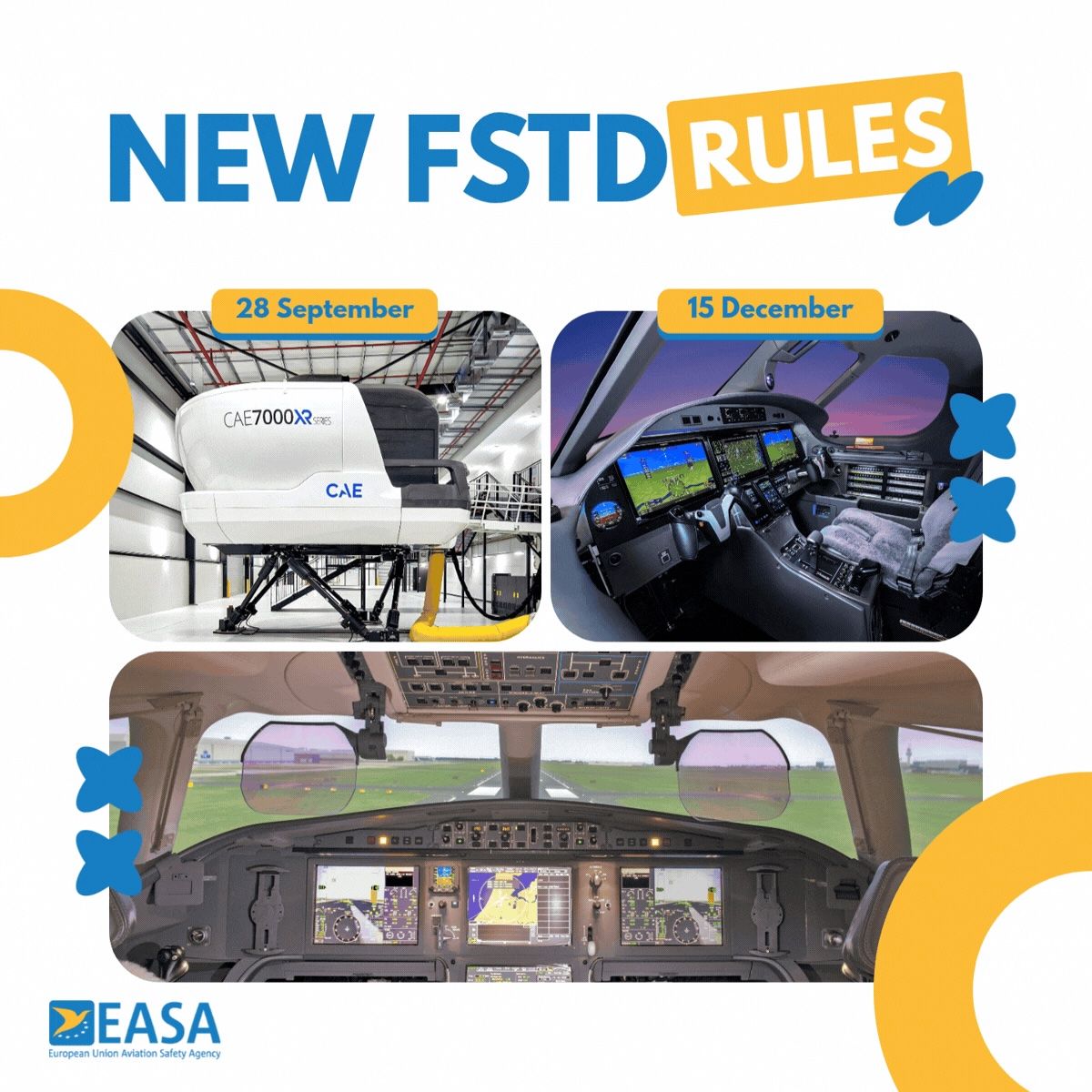
Europe – The European Union Aviation Safety Agency (EASA) has opened a series of implementation-support events for its new capability-based Flight Simulation Training Device framework, beginning with an online webinar on September 28, 2026 and followed by a full-day hybrid information session on December 15. The activities are aimed at ATOs, airlines, simulator operators and manufacturers preparing for the new FSTD Capability Signature (FCS) framework before it becomes applicable on April 30, 2028.
- The first webinar will run for one hour on September 28, from 12:30 to 13:30 CET, and is free to attend online. EASA will cover:
- The FSTD Capability Signature and its intended use.
- EASA’s regulatory approach to the FCS framework.
- Implementation support available to industry.
- The expected impact on affected stakeholders.
Stakeholders can submit questions to EASA until September 20.
- The second event will take place on December 15 from 09:00 to 17:00 CET as a hybrid session at EASA headquarters in Cologne and online. Physical attendance is limited to 100 participants, with one on-site representative per organisation and priority given to competent authorities, ATOs, air operators, FSTD operators and manufacturers, data providers, aircraft manufacturers, pilots, instructors and examiners.
- The December session will cover Regulation (EU) 2026/781, amendments to the Aircrew and Air Operations regulations, associated Acceptable Means of Compliance and Guidance Material, and CS-FSTD Issue 1. EASA is accepting stakeholder questions for that event until November 10.
- EASA’s implementation program also provides for:
- An Implementation Support Manual planned for Q1 2027.
- Domain-specific workshops during 2027.
- Frequently asked questions and further guidance.
- Implementation Support Task IST.0007 covering the transition to the FCS framework.
- The regulatory framework introduces the FSTD Capability Signature, which describes individual devices through defined technical features and fidelity levels rather than relying principally on existing fixed simulator categories and qualification levels. This allows training organisations, operators and authorities to assess a device according to the capabilities it can provide for a particular training requirement.
- The framework also introduces an optional task-to-tool methodology for aeroplane and helicopter type-rating training and operator recurrent training. Under this approach, an ATO or operator can identify the capabilities and fidelity required for a training objective and select an FSTD that meets those requirements. EASA states that the methodology can be used with both traditional and competency-based training approaches.
- CS-FSTD Issue 1 also creates qualification provisions for technologies not fully addressed under the previous structure, including:
- Extended reality (XR).
- Touchscreen-based flight deck interfaces.
- Training devices that do not fit existing simulator categories.
- Regulation (EU) 2026/781 and CS-FSTD Issue 1 become applicable on April 30, 2028. Until then, the existing CS-FSTD(A) Issue 2 and CS-FSTD(H) standards remain applicable for aeroplane and helicopter simulator qualification.
Source: EASA
You may also check our Terms and Conditions for our Content Policy. Searching for specific information - kindly contact us to see if we can assist you.
Related News
Share
Loading Ad...
Recommend this Post
Please fill out the form below and the AFM platform will send this post via email to your preferred recipient