Picture credits: FlightSense
 Click to view
August 18, 2026
USA – Flight training technology provider FlightSense has expanded its AI-supported training platform into flight school operations, adding scheduling, aircraft dispatch, maintenance and airworthiness tracking, invoicing and compliance monitoring alongside its existing training-record and student-performance functions. The expansion allows Part 61 and Part 141 operators to connect training records directly with aircraft availability, instructor currency and commercial workflows within one system, reducing reliance on separate operational and training-management platforms.
- The new scheduling capability provides an organisation-wide calendar covering aircraft flights, ground lessons, solo flights and checkrides, with conflict detection based on aircraft and personnel availability. FlightSense also surfaces aircraft grounding, compliance gaps and open squawks within the scheduling workflow.
- The aircraft-dispatch function includes a flight-release process that checks instructor and student compliance, aircraft status, maintenance discrepancies and current weather before departure. A grounded aircraft or an open “Do Not Fly” squawk prevents normal dispatch, although authorised personnel can record an override where the platform permits one.
- Maintenance functions cover aircraft discrepancies with photo attachments, annual and 100-hour inspections, transponder, pitot-static and ELT requirements, airworthiness directives and ARROW documentation. The system calculates remaining time against 100-hour inspections using aircraft meter records.
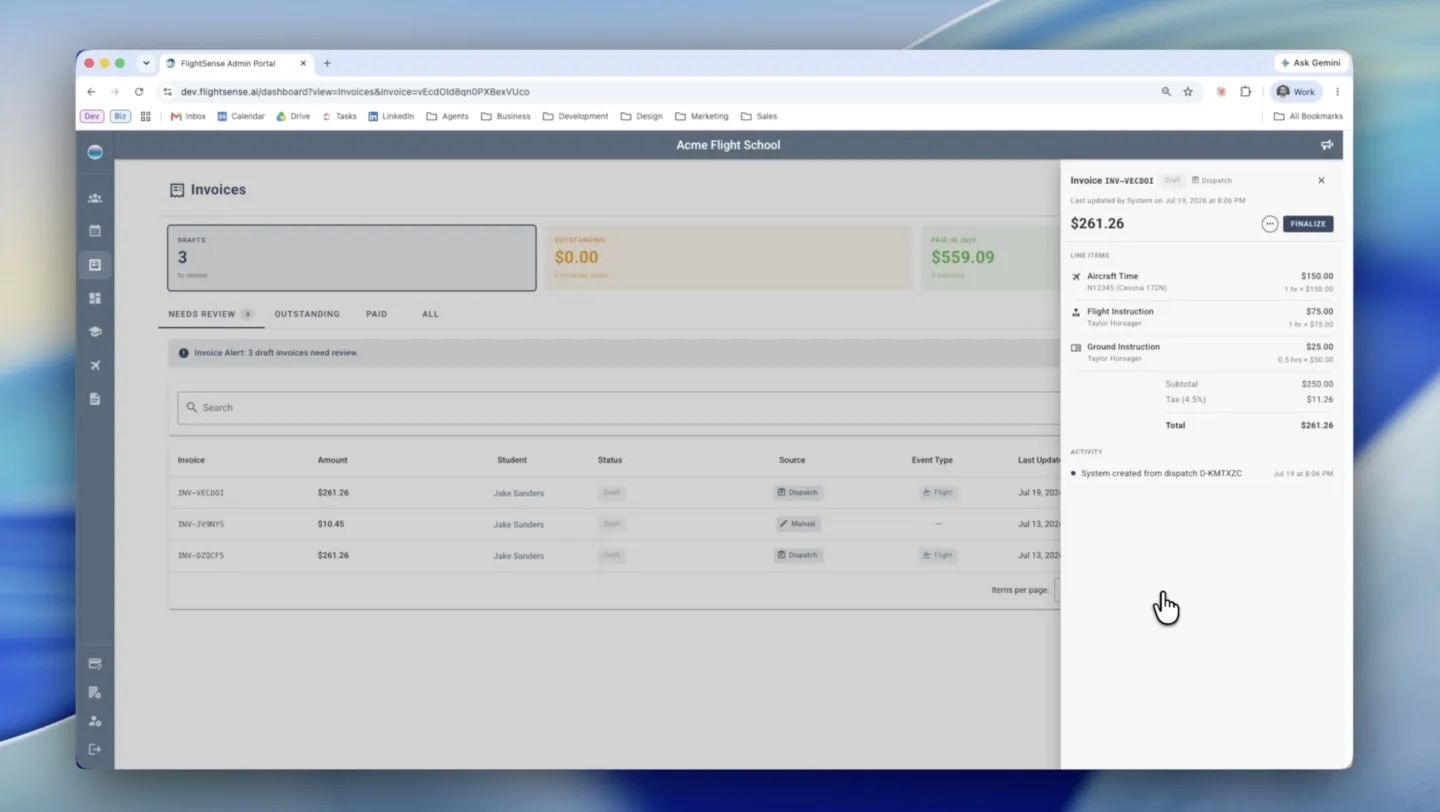
- Completed flights can now generate draft invoices using aircraft meter readings, instruction time, operator-defined rates and taxes. FlightSense currently supports invoice creation and status tracking; online payment collection has not yet been released and was identified by the company as a future capability.
- FlightSense’s underlying training functions include voice-based lesson debriefing, automated identification of relevant Airman Certification Standards tasks, student proficiency tracking, course progress monitoring and performance analytics intended to identify students requiring additional attention before checkrides.
- Its AI aviation assistant, Amelia, uses FAA regulatory and theoretical source material and can incorporate an individual student’s training record when responding to training questions.
- FlightSense positions the platform as Part 141-ready rather than as an FAA-approved software product. The company states that a Part 141 school’s FAA principal inspector accepted FlightSense as that organisation’s recordkeeping system under a Letter of Authorization and that the school subsequently completed its Part 141 certification inspection using FlightSense as its system of record.
- The Part 141 functionality includes digital training and stage-check records, instructor qualification tracking, course enrolment, graduation documentation, transfer credits, electronic signatures and one-click student record exports. FlightSense publishes a compliance crosswalk covering relevant provisions of 14 CFR Parts 141 and 61, AC 141-1B and AC 120-78.
- The expanded platform is available through the web and FlightSense’s iOS application. Its current flight school plan is publicly priced at $15 per seat per month, while larger Part 141 schools and university programmes are offered enterprise pricing and integrations.
- AFM previously reported that flight school operations platform Sky Schedule integrated with FlightSense in February 2026 to add FlightSense’s student flight-performance analytics, ADS-B-based tracking and structured debrief data to Sky Schedule’s operational workflows. FlightSense’s latest expansion moves the company itself into scheduling, dispatch, maintenance and billing functions that were previously supplied through complementary operational platforms.
Statements
- “Flight schools do not sell airplane time. They produce certificated pilots, and they have to prove it to the FAA. We started with the hardest part of that, the training record, because it is the part everyone else treats as an afterthought. Now the whole operation runs on top of it. A school can schedule, dispatch, and bill without the record ever falling out of sync,” said Taylor Horsager, Founder and CEO at FlightSense.
About FlightSense
FlightSense is a Lehi, Utah-based aviation software company founded in 2024 and led by commercial pilot and Certified Flight Instructor Taylor Horsager. Its platform combines flight-training records, AI-supported debriefing and student analytics with scheduling, dispatch, compliance, aircraft maintenance tracking and billing for Part 61 and Part 141 flight schools. The company currently reports more than 750 pilots using its platform and states that one Part 141 school has received FAA principal-inspector acceptance to use FlightSense as its recordkeeping system under a Letter of Authorization.
Source: FlightSense
You may also check our Terms and Conditions for our Content Policy. Searching for specific information - kindly contact us to see if we can assist you.
Related News
Share
Loading Ad...
Recommend this Post
Please fill out the form below and the AFM platform will send this post via email to your preferred recipient