Picture credits: IATA
 Click to view
October 6, 2026
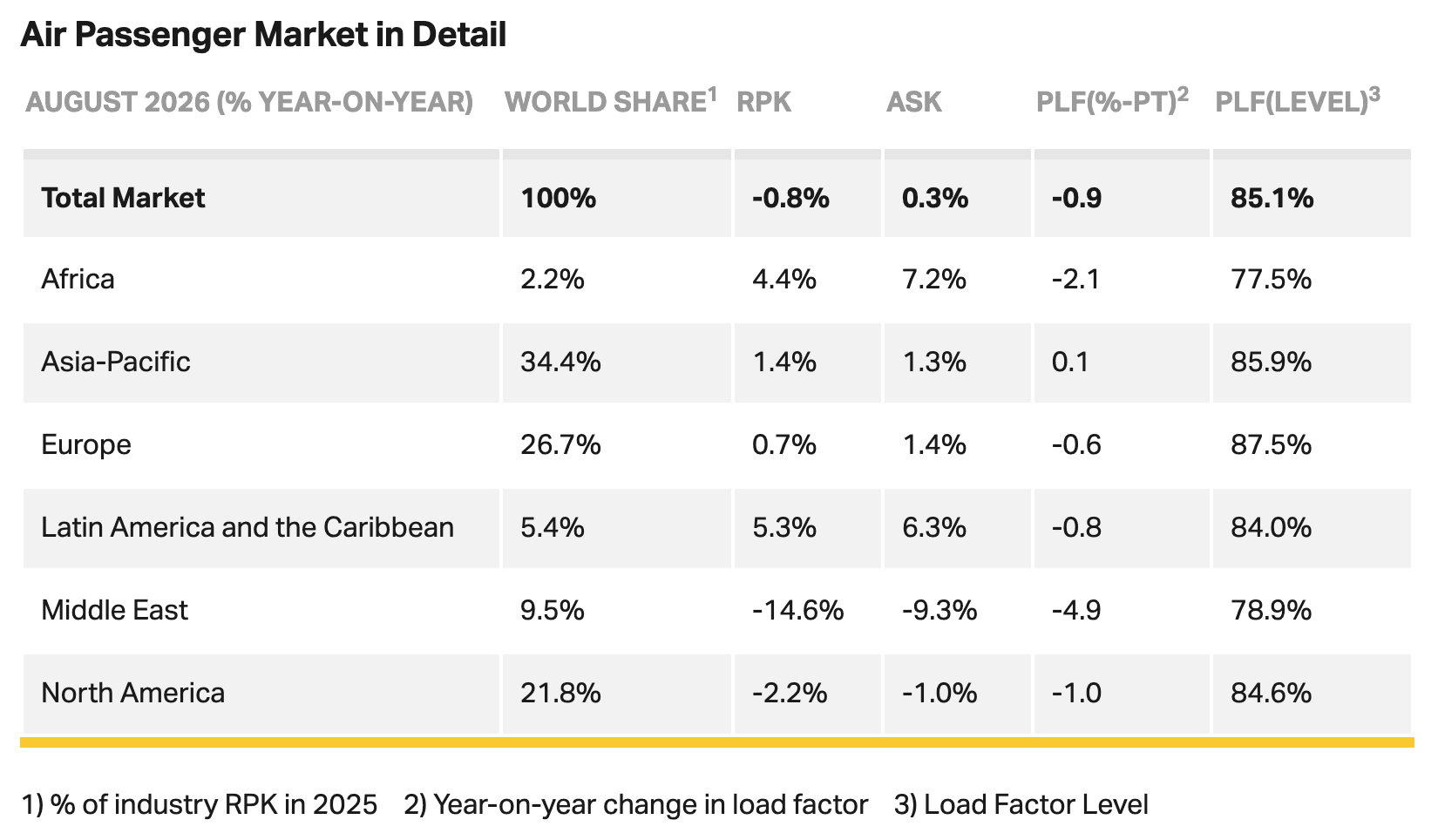
Global – The International Air Transport Association (IATA) reported a 0.8% year-on-year decline in global airline passenger demand in August 2026, reversing the 0.2% growth recorded in July, while scheduled seat capacity for October points to a 2.0% year-on-year increase.
- Global revenue passenger kilometres fell 0.8% year-on-year in August, while available seat kilometres increased 0.3%. Passenger load factor declined 0.9 percentage points to 85.1%. Excluding Middle Eastern carriers, global demand increased 0.6%.
- International passenger demand declined 0.9%, with capacity unchanged and load factor falling 0.8 percentage points to 85.0%. Excluding Middle Eastern carriers, international demand increased 1.3%. Domestic demand decreased 0.5% while capacity rose 0.7%.
- Middle Eastern carriers recorded the largest regional contraction, with total passenger demand down 14.6% and capacity 9.3% lower than August 2025. International demand for the region declined 14.2%, reversing the gradual improvement recorded in previous months.
- Latin America and the Caribbean recorded the strongest total-market demand increase at 5.3%, followed by Africa at 4.4%. Asia-Pacific demand increased 1.4% and Europe 0.7%, while North America declined 2.2%.
- Within international markets, European airline demand increased 2.1%, Latin American and African carriers each recorded 6.7% growth, while Asia-Pacific international traffic slipped 0.1%. Europe-Asia traffic increased 12.2%, whereas transatlantic traffic declined 2.4%.
- Domestic China recorded 5.8% demand growth, while domestic India fell 7.5%, the United States declined 2.9% and Japan decreased 2.0%. Australia and Brazil recorded increases of 2.3% and 4.3%, respectively.
- IATA said forward airline schedules show available seats increasing 2.0% year-on-year in October. If deployed as planned, that capacity growth would require airlines to maintain or increase aircraft utilisation and corresponding flight crew availability even as passenger-demand performance remains uneven across markets.
- AFM previously reported that global passenger demand returned to 0.2% year-on-year growth in July 2026 after three consecutive months of contraction, following declines of 3.4% in April, 2.2% in May and 1.7% in June. August therefore represents a renewed contraction rather than a continuation of July’s recovery.
Statements
- “Global demand for air transport contracted by 0.8% compared to August 2025 as the recovery trajectory for carriers in the Middle East was interrupted. The region’s carriers reported that demand was 14.6% lower year-on-year, reversing an improving trend. Excluding the Middle East carriers, demand for air travel grew by 0.6% year-on-year in August, half the pace seen in July. With some important exceptions such as domestic China, global connectivity was generally weaker in August. The coming months will reveal whether travelers, whose purchasing power has been reduced by higher energy prices, are adjusting their travel budgets, and might be discouraged from traveling due to the prevailing geopolitical instability. In the meantime, forward schedules for October are showing cautious optimism with 2.0% growth in available seats,” said Marie Owens Thomsen, Senior Vice President Sustainability and Chief Economist at IATA.
Source: IATA
You may also check our Terms and Conditions for our Content Policy. Searching for specific information - kindly contact us to see if we can assist you.
Related News
Page 1
Share
Loading Ad...
Recommend this Post
Please fill out the form below and the AFM platform will send this post via email to your preferred recipient