Picture credits: IATA
 Click to view
September 1, 2026
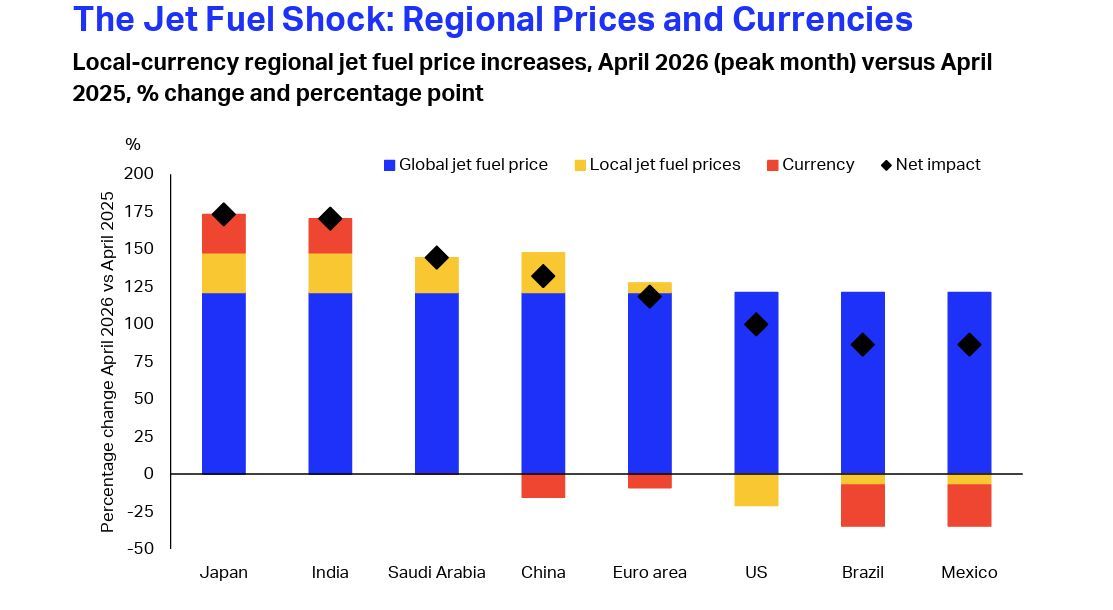
Global – The International Air Transport Association (IATA) has reported that global jet fuel prices increased 121% year-on-year between April 2025 and their April 2026 peak, with exchange rates and regional fuel benchmarks producing materially different cost increases for airlines across major markets.
- Japan recorded one of the largest increases, with the local-currency price of jet fuel rising 173%. IATA attributed this to a 148% increase in the regional jet fuel price combined with a 10% depreciation of the Japanese yen against the US dollar.
- India followed with a 170% increase in the local-currency price of jet fuel, reflecting both above-average regional fuel-price increases and currency depreciation.
- Chinese airlines faced a 132% increase despite a stronger renminbi, because regional fuel prices increased faster than the global average. In the euro area, currency appreciation limited the local-currency increase to 118%.
- Brazil and Mexico were comparatively less exposed. IATA said the Brazilian real and Mexican peso each appreciated by approximately 15% against the US dollar, helping limit the local-currency fuel-price increase to 86%.
- IATA’s June 2026 financial outlook forecasts the global airline fuel bill reaching $350 billion this year, nearly 40% above $252 billion in 2025. Jet fuel is expected to average $152 per barrel, almost 70% above the 2025 average of $90.
- Fuel is consequently forecast to account for 31.4% of airline operating expenses in 2026, up from 25.4% in 2025. IATA estimates that airlines have hedged approximately one-third of their expected 2026 fuel consumption, reducing short-term volatility without eliminating exposure to sustained high prices or widening jet-fuel crack spreads.
- The fuel shock contributed to IATA reducing its 2026 global airline net-profit forecast to $23 billion from the $41 billion projected in December 2025. The expected net margin has fallen from 3.9% in the earlier forecast to 2.0%, while operating profit is now forecast at $48 billion compared with $76.4 billion achieved in 2025.
- Despite weaker profitability, IATA expects industry revenues to reach $1.165 trillion and passenger numbers to reach 5.1 billion in 2026. Airline employment is forecast at 3.33 million people, 1% higher than in 2025, with labour costs rising 4% to $271 billion.
- IATA also reported that productivity per airline employee is expected to decline 0.4%, noting that airlines are prioritising operational resilience and have a larger proportion of recently recruited employees following post-pandemic hiring. This provides continued training and qualification requirements even as financial headroom narrows.
- AFM previously reported that global passenger demand fell 1.7% year-on-year in June 2026, with IATA warning at that time that higher fuel prices were adding pressure to fares and airline recovery. The latest fuel analysis provides additional detail on how that cost shock differs by national and regional market.
Source: IATA
You may also check our Terms and Conditions for our Content Policy. Searching for specific information - kindly contact us to see if we can assist you.
Related News
Page 1
Share
Loading Ad...
Recommend this Post
Please fill out the form below and the AFM platform will send this post via email to your preferred recipient