Picture credits: IATA
 Click to view
August 3, 2026
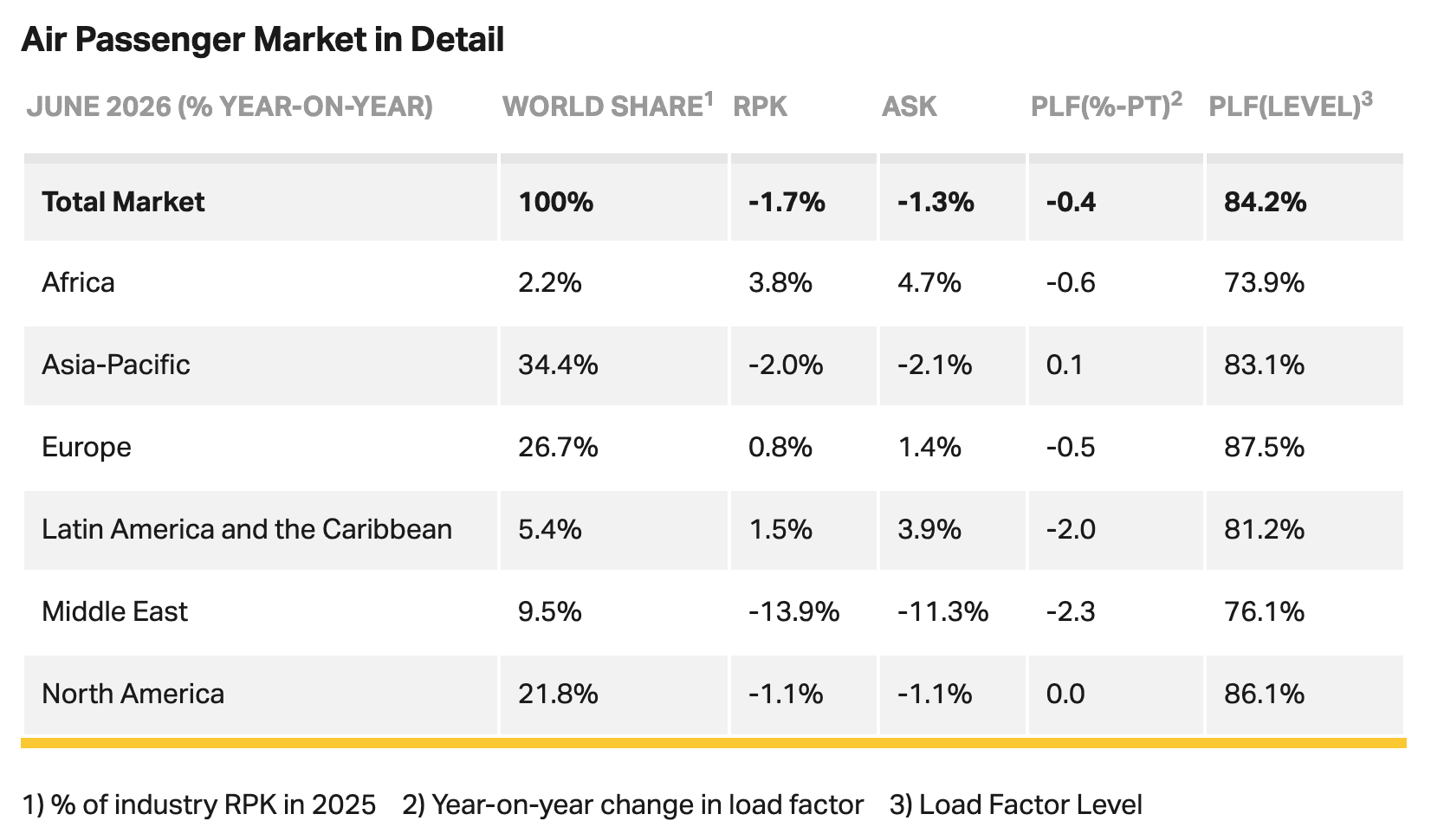
Global – The International Air Transport Association (IATA) reported that global passenger demand fell 1.7% year-on-year in June 2026, with international demand declining 0.9% and domestic demand contracting 3.0%.
- Global revenue passenger kilometres declined 1.7% compared with June 2025, while available seat kilometres decreased 1.3%. The industry-wide passenger load factor fell 0.4 percentage points to 84.2%.
- The June contraction was smaller than the 3.4% year-on-year decline recorded in April and the 2.2% reduction reported in May. This marked a third consecutive month of lower global passenger demand, although the rate of contraction continued to moderate.
- Excluding Middle Eastern carriers, total global demand declined 0.6%. International traffic excluding the Middle East increased 1.1%, showing that the region remained a primary source of weakness in the worldwide result.
- International passenger demand fell 0.9%, against a 0.6% reduction in capacity. The international load factor declined 0.2 percentage points to 84.2%.
- Domestic passenger demand contracted 3.0%, while domestic capacity decreased 2.4%. The domestic passenger load factor fell 0.5 percentage points to 84.0%.
- China recorded the largest contraction among the major domestic markets at 5.2%, followed by Japan at 3.8%, the United States at 1.2% and India at 0.5%. Australian domestic demand was unchanged, while Brazil increased 0.9%.
- Middle Eastern carriers recorded a 13.9% reduction in total passenger traffic and an 11.3% decrease in capacity, with the regional load factor falling 2.3 percentage points to 76.1%. International demand carried by Middle Eastern airlines declined 14.0%, compared with contractions of 28.8% in May and 48.1% in April.
- Asia-Pacific carriers reported a 2.0% reduction in total demand and a 2.1% decrease in capacity. International demand increased 0.4%, but capacity on international routes within Asia fell 4.8% as some airlines reduced short-haul operations amid higher fuel prices.
- North American carriers recorded a 1.1% decline in total demand and capacity. International passenger traffic fell 1.0%, while international capacity decreased 0.7% and the load factor declined 0.3 percentage points to 86.9%.
- Europe was the largest regional market to record total growth, with demand increasing 0.8% and capacity rising 1.4%. European international traffic increased 1.5%, while the Europe–Asia corridor grew 11.0%, the fastest rate among the major international route groups measured by IATA.
- African carriers recorded the strongest international growth at 6.7%, supported by a 7.0% capacity increase. Latin American carriers reported 3.5% international demand growth, compared with a 6.3% increase in capacity.
- Capacity growth exceeded demand in Africa, Europe and Latin America and the Caribbean, producing lower load factors despite positive passenger growth. Latin America and the Caribbean recorded the largest total-market load-factor decline outside the Middle East, falling two percentage points to 81.2%.
- IATA attributed the June result principally to domestic-market weakness in China, the United States and Japan and to international traffic disruption affecting Middle Eastern carriers. It also warned that higher fuel prices and renewed regional tensions could continue to affect fares and airline recovery.
- IATA stated that its June figures are provisional and include estimates for missing data. Historical passenger traffic figures may subsequently be revised.
- AFM previously reported that global passenger demand contracted 3.4% in April 2026, the first year-on-year decline since the post-pandemic recovery, as traffic carried by Middle Eastern airlines fell 46.6%. The June data shows an easing of the overall contraction but continued weakness across several major domestic markets.
- AFM also previously reported that IATA’s central long-term scenario forecasts global passenger traffic reaching 20.8 trillion revenue passenger kilometres by 2050, more than double the 2024 level.
Statements
- “Global demand for air travel was down 1.7% in June compared to 2025. This is largely due to domestic market declines in China, the US, and Japan, and weak but improving international demand for Middle East carriers. While Middle East performance improved, renewed tensions will not help the region’s recovery and the knock-on impact of rising fuel prices will continue to burden travelers with higher airfares. People continue to travel, which is an important contributor to global economic growth. There is no doubt, however, that stabilizing the situation in the Middle East and normalizing oil supplies would improve prospects for airlines, economies, and societies the world over,” said Willie Walsh, Director General of IATA.
Source: IATA
You may also check our Terms and Conditions for our Content Policy. Searching for specific information - kindly contact us to see if we can assist you.
Related News
Page 1
Share
Loading Ad...
Recommend this Post
Please fill out the form below and the AFM platform will send this post via email to your preferred recipient