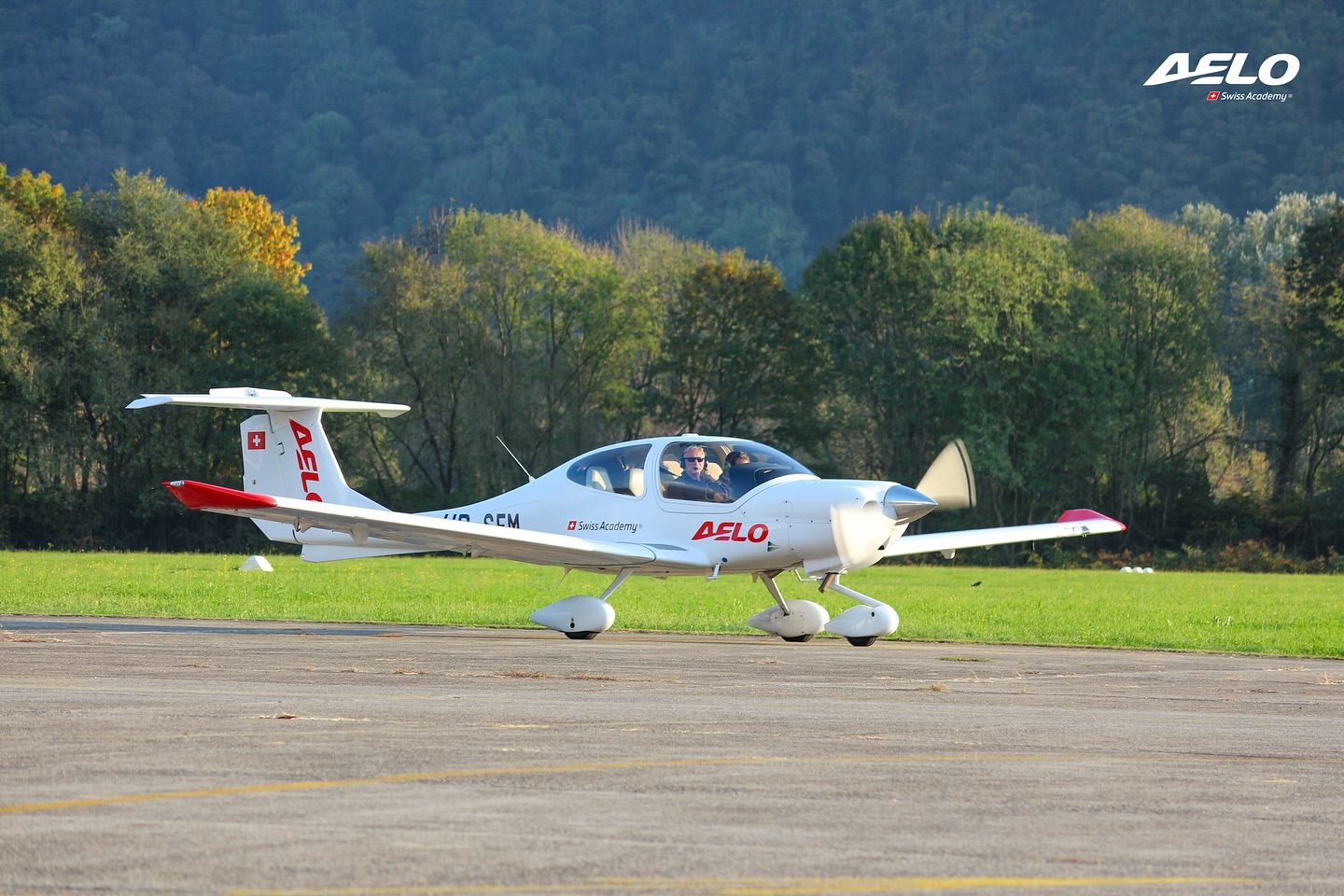
Picture credits: AELO Swiss Academy
 Click to view
September 14, 2026
Switzerland - A 129% year-on-year increase aircraft flight hours in August illustrates the scale of AELO Swiss Academy’s growth, but increasing activity is only part of the challenge. The larger task is ensuring that aircraft, instructors, maintenance, planning systems and student support develop together, while continuing to listen closely to the students themselves.
In August 2025, AELO’s aircraft recorded approximately 791 flight hours. In August 2026, that figure reached 1,810 hours, an increase of approximately 129% in just twelve months.
The scale of the operation during August goes considerably further. AELO completed 1,857 flight events, with aircraft generating over 1,800 of airborne flight time. When simulator activity is included, total training activity reached 2,283 hours during the month. Integrated ATPL training alone accounted for more than 1,462 flight hours, alongside Air France cadet training, PPL, APS MCC, hour building and other operations.
These figures demonstrate growing capacity. More importantly, however, they demonstrate the increasing organisational complexity involved in delivering professional pilot training at scale.
For AELO, the objective has never simply been to fly more hours. The challenge is to increase capacity while continuing to deliver the quality, safety and individual attention expected from a professional airline-focused training academy.
Flight training is an unusually complex operating environment. Growth has to be planned before it can be delivered and this requires considerably more than purchasing additional aircraft.
An aircraft cannot simply be added to a fleet and immediately translated into additional student capacity. Each aircraft creates additional requirements for maintenance, technical oversight, instructor availability, scheduling, spare capacity, operational supervision and long-term fleet planning.
At the same time, every student progresses through the programme differently. Weather, individual learning pace, aircraft availability, instructor qualifications, maintenance requirements and the transition between VFR and IFR phases all affect how training has to be organised.
Scaling therefore requires the different parts of the organisation to grow together.
Since the beginning of 2026, AELO has phased in 10 additional aircraft, including two Tecnam P2008s, three Diamond DA20s, four DA40s and one DA42. The Academy’s overall training fleet has consequently grown to 34 aircraft.
This investment has been accompanied by the recruitment of additional qualified VFR and IFR instructors to ensure that increased aircraft capacity is matched by the instructional resources required to use it effectively.
The August operational figures show how these investments are translating into activity. VFR aircraft generated more than 1,020 airborne hours during the month, while IFR aircraft contributed almost 790 hours. The DA40 fleet alone accounted for more than 632 flight hours, with the DA42 fleet adding a further 156 hours.
Stefano Buratti, CEO and Head of Training of AELO Swiss Academy, said: “Reaching this level of activity has required an extraordinary amount of work and perseverance. Scaling a flight academy is an engineering, operational and business challenge all at once: you have to anticipate demand, invest in the right aircraft, recruit and develop instructors, expand maintenance capability and build the planning systems and organisational structure capable of bringing everything together. My engineering and corporate background has certainly helped me approach that complexity systematically, but no individual achieves a milestone like this alone. Behind these numbers is an incredibly dedicated team that has worked extremely hard, adapted constantly and overcome many challenges to get us here.”
Maintenance, planning and operational resilience
Growth in flight activity has also increased the demands placed on maintenance and operational coordination. More flying means more inspections, greater component utilisation and a higher need to align technical availability with student schedules.
AELO has therefore continued adapting its maintenance organisation alongside the expansion of the fleet, with the objective of maintaining aircraft availability while ensuring that technical standards are never compromised.
At the same time, planning has become increasingly strategic. AELO now has a dedicated team of three planners, coordinated by Operations Manager Margot Bartelds, bringing together aircraft availability, instructor qualifications, maintenance requirements, student progression and operational constraints.
The aim is not only to build workable schedules, but to provide greater visibility and continuity throughout each student’s training journey.
Listening to students
This became particularly clear through the recent student satisfaction research conducted by Avioneer, combining structured survey responses with in-depth student interviews.
Students rated several core elements of the AELO experience highly, particularly flight training quality, instructors, aircraft, facilities and location.
The survey also highlighted the importance students place on communication, predictability and visibility of their training progression.
Professional flight training will always be affected by variables such as weather, maintenance and instructor availability. The research showed that students generally understand this, but value knowing how those factors may affect them individually and what they can expect next.
That insight helped AELO broaden its focus from capacity alone to the wider student experience.
Alongside aircraft, instructors, simulators and maintenance capability, the Academy has strengthened planning, operational coordination and student support.
AELO now has three dedicated Student Support professionals, helping students with their day-to-day non-training needs while ensuring they have clear points of contact and access to relevant information.
The planning and Student Support functions are increasingly aligned, helping students gain better visibility not just of their next flight, but of their wider training progression.
Preparing for the next stage
The increase of flight hours in one year is an important milestone, but AELO is already preparing for the next phase of growth.
A further nine Diamond DA20 aircraft are scheduled to join the fleet, with four expected to be delivered by December 2026 and the remaining aircraft arriving progressively during January, February and March 2027.
At the same time, AELO is increasing capacity across its satellite bases at Lugano and Cuneo airports, with additional aircraft to be based at both locations. This will help distribute training activity more effectively, increase operational flexibility and create additional capacity across the Academy’s network.
AELO will continue using both operational data and student feedback to guide these investments and ensure that growth remains sustainable, predictable and aligned with student needs.
Because ultimately, AELO’s growth will be measured not only by increased capacity, but by how effectively that capacity translates into a consistent, high-quality training experience for students.
Source: AELO Swiss Academy
You may also check our Terms and Conditions for our Content Policy. Searching for specific information - kindly contact us to see if we can assist you.
Related News
Share
Loading Ad...
Recommend this Post
Please fill out the form below and the AFM platform will send this post via email to your preferred recipient