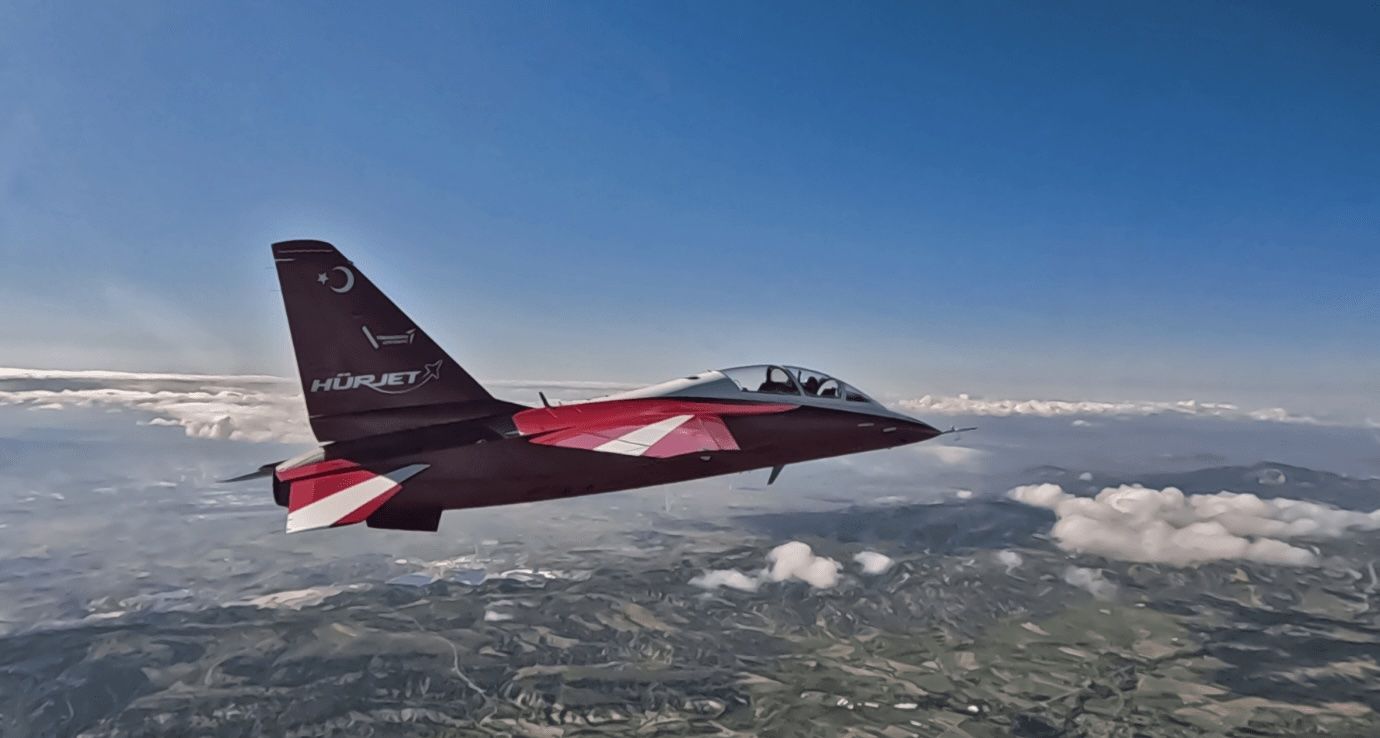
Picture credits: TAI
 Click to view
July 31, 2026
United Kingdom – Turkish Aerospace Industries (TAI) is evaluating whether to offer its HÜRJET advanced jet trainer for the United Kingdom’s future fast-jet training requirement as it expands the program’s flight-test fleet and develops combat and naval variants. Participation would place HÜRJET in competition for a training system expected to replace the Royal Air Force’s Hawk aircraft and support preparation for Typhoon, F-35 and future combat-air operations.
- Two flying HÜRJET prototypes have accumulated close to 500 flight hours, according to Turkish Aerospace Industries President and CEO Mehmet Demiroğlu. Four additional prototypes are expected to join the flight-test programme during 2026, taking the development fleet to six aircraft.
- Turkish Aerospace Industries said it will monitor the UK requirement and engage with authorities before deciding whether to participate.
- The future UK requirement is intended to succeed the Hawk T2 advanced trainer and Hawk T1 aircraft used for training and other RAF roles. AFM previously reported that a competitive procurement was expected to begin in 2026, with HÜRJET, the Korea Aerospace Industries T-50 and Leonardo M-346 identified among potential candidates.
- BAE Systems, Boeing and Saab formalised a competing UK offer based on the Boeing T-7 in July 2026. Their proposal includes a UK final-assembly and integration facility and combines aircraft operations with synthetic training for pilots progressing towards Typhoon, F-35 and future combat aircraft.
- Turkish Aerospace Industries’s official aircraft information describes HÜRJET as a single-engine, tandem-seat advanced trainer powered by a GE Aerospace F404 engine, with a maximum speed of Mach 1.4, a 45,000-foot service ceiling and a 7,500-pound payload capacity. The aircraft is designed for advanced jet training, fighter-fundamentals instruction, aggressor and aerobatic roles.
- Spain became HÜRJET’s first European and NATO export customer through its Airbus-led Integrated Combat Training System program. The contract covers 30 aircraft, designated SAETA II after Spanish modification, together with simulators, ground instruction and operational and maintenance support.
- The first 21 aircraft for Spain are scheduled to begin arriving in an initial configuration from 2028. All 30 aircraft will subsequently receive Spanish avionics and mission-system modifications, with completed SAETA II deliveries planned between 2031 and 2035.
- Spain’s ground-based training system is planned to include mission simulators, virtual-reality devices, computer-based training and supporting instructional facilities at Talavera la Real Air Base. It is scheduled to enter operation during the 2029–2030 academic year.
- AFM previously reported that HÜRJET had moved from prototype evaluation towards serial production, with Turkish Aerospace establishing capacity to manufacture two aircraft per month and the Turkish Air Force expected to receive an initial 16-aircraft batch.
Source: TAI
You may also check our Terms and Conditions for our Content Policy. Searching for specific information - kindly contact us to see if we can assist you.
Related News
Share
Loading Ad...
Recommend this Post
Please fill out the form below and the AFM platform will send this post via email to your preferred recipient