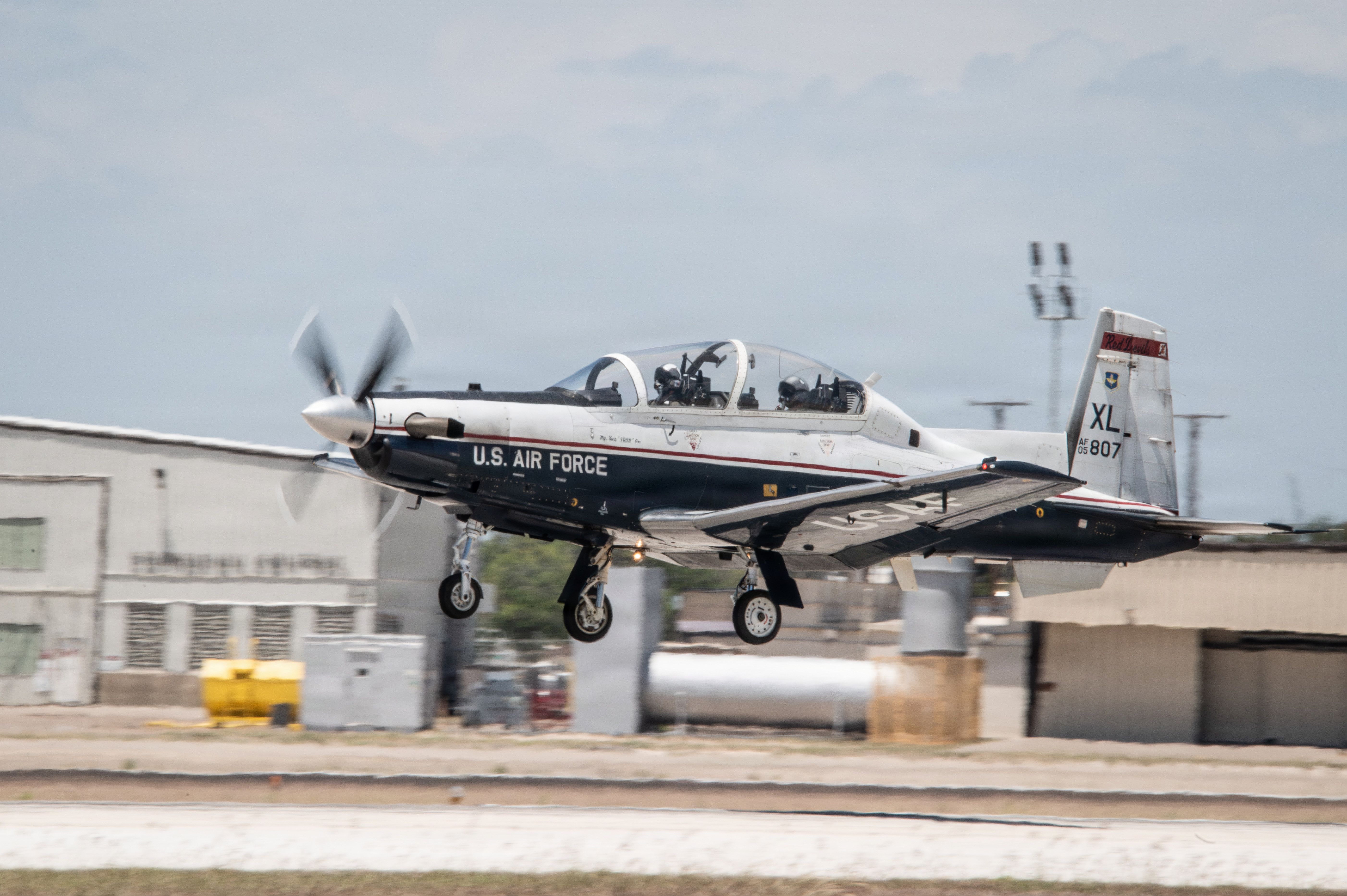
Picture credits: Air Education and Training Command
 Click to view
October 1, 2026
Texas, USA – U.S. Air Education and Training Command (AETC) said its redesigned Future of Undergraduate Pilot Training (FUPT) model is on track to produce 1,500 pilots in fiscal year 2026, reaching the annual production level targeted when the Air Force began restructuring its pilot training pipeline. The model shifts foundational flying to civilian FAA Part 141 providers while reserving military aircraft, instructors and simulator capacity for military-specific training.
- The 1,500-pilot production level is intended to support active-duty, Air Force Reserve, Air National Guard and international pilot requirements while helping address what AETC describes as a shortfall of approximately 2,407 pilots. AETC says the latest output demonstrates that the redesigned training structure can be scaled while it continues to assess graduate quality.
- Under FUPT, student pilots first complete Initial Pilot Training with civilian aviation programs in Texas, Arizona, Florida and Georgia using FAA Part 141 syllabi. The civilian phase leads to a Private Pilot Certificate, Instrument Rating and Multi-Engine Rating before students transition into military aircraft.
- Students now enter the military portion of the pipeline with approximately 120 flight hours, compared with roughly 30 hours under the previous Initial Flight Training model. AETC has previously set a maximum 139-calendar-day period for the civilian IPT phase.
- The military phase is centered on the T-6A Texan II and advanced simulation. Earlier AETC planning described the redesigned military portion as approximately 108 training days, including around 55 flying hours in the T-6A and 50 simulator hours before students earn their Air Force pilot wings.
- Nineteenth Air Force converted the T-6 syllabus to a competency-based model aligned with operational requirements. AETC reports that the redesign reduced T-6 training days by 31%, allowing instructor pilots to focus earlier on military-specific competencies rather than foundational aircraft handling.
- AETC states that using civilian flight schools for the initial phase has effectively created training capacity comparable with an additional military flying training wing without requiring the Air Force to establish another military training installation.
- The FUPT concept was initially tested with small groups beginning in 2024. AETC reported in January 2025 that 65 student pilots were participating in trials in Arizona and Texas, using approximately 110 flying hours to complete private, instrument and multi-engine qualifications before moving into the military phase.
- The wider modernization program also includes changes to advanced training. The Air Force is introducing the Boeing T-7A Red Hawk and its associated Ground-Based Training System as the eventual replacement for the T-38C, with three T-7As delivered to Joint Base San Antonio-Randolph by late August 2026 for instructor development and training-system integration.
Statements
- “Reaching 1,500 pilots is a milestone, but it is not the finish line. FUPT was built to overcome long-standing constraints including instructor shortages and aircraft availability to deliver the aviators our combatant commanders require,” said Lt. Gen. Clark J. Quinn, Commander of Air Education and Training Command.
- “The goal is to produce elite aviators through a training system that is more deliberate, data-driven, and aligned with the demands of operational units,” said Maj. Gen. Travolis Simmons, Commander of Nineteenth Air Force.
Source: Air Education and Training Command
You may also check our Terms and Conditions for our Content Policy. Searching for specific information - kindly contact us to see if we can assist you.
Related News
Share
Loading Ad...
Recommend this Post
Please fill out the form below and the AFM platform will send this post via email to your preferred recipient